What is compliance debt?
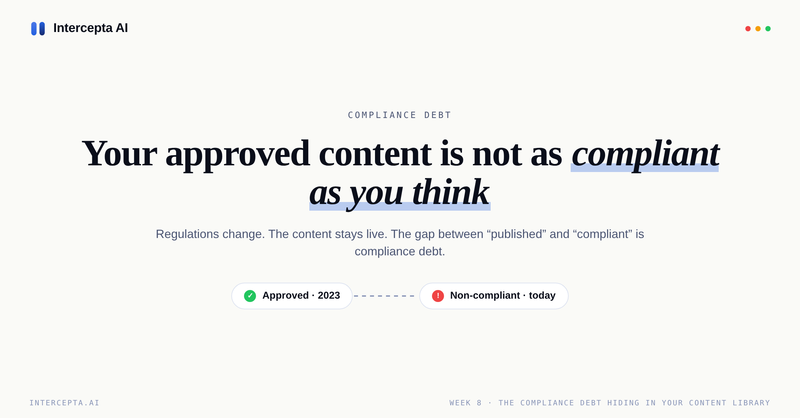
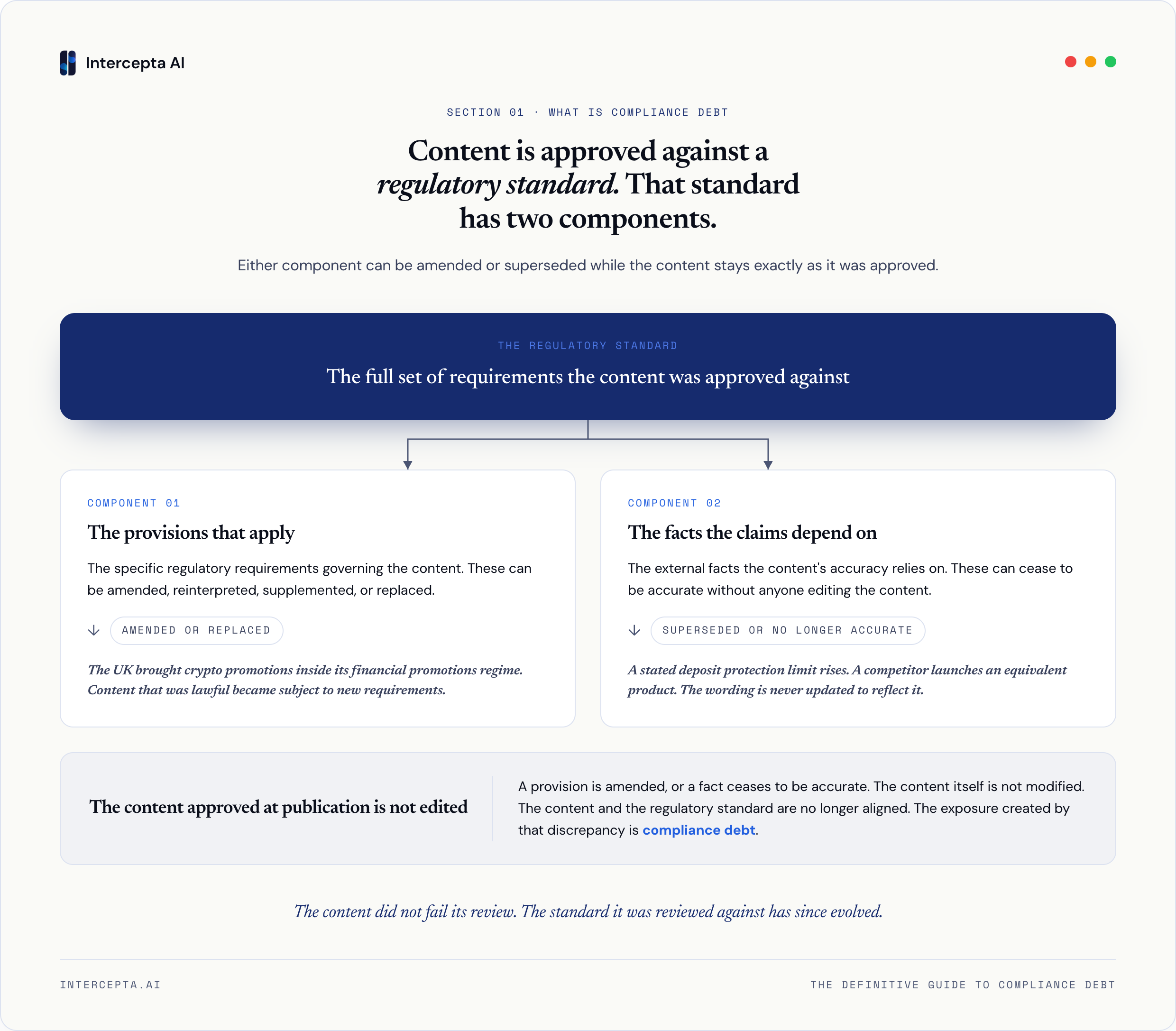
Compliance debt is the regulatory exposure that accumulates when content that was compliant at publication becomes non-compliant without being changed. It is found in an organisation's live marketing content, across its various channels and in its digital asset management and content management systems. The regulatory standard the content was approved against has two components, the provisions that apply and the facts the content's claims depend on, and either can be amended or superseded while the content stays as it was approved. Each time that happens, the debt compounds without leaving a visible trace, because the content itself looks exactly as it did on the day it was cleared.
Once cleared as compliant, content tends to stay live for years. It is often reused and repurposed long after the review that cleared it while the regulatory standard it was approved against is amended, reinterpreted and replaced on a timeline the firm does not control. As a result, the longer the content is not subjected to re-evaluation, the further it drifts from what compliance now requires.
Compliance debt is easily confused with ordinary non-compliance, but the two are distinct. Ordinary non-compliance is content that breached the regulations at the point it was published. Compliance debt is content that was compliant when published and later fell out of compliance without being altered. One is an oversight during the approval process. The other is a form of decay that sets in afterwards.
Content falls out of compliance in two ways, and neither involves editing the content. The first is an amendment to the governing provisions. Content approved under the requirements that applied at the time becomes non-compliant when those requirements are amended, as happened when the United Kingdom brought crypto asset promotions inside its financial promotions regime and organisations had to amend or withdraw any promotion that no longer complied.
The second is factual decay. A statement that was well-founded when published can become inaccurate if the underlying fact it depended on is no longer accurate, for example when a protection threshold is raised or a competitor launches an equivalent product, and the initial copy is not updated to reflect it.
Compliance debt is therefore a measurement and process problem rather than an editorial issue. Typically, the content did not fail its original review. The exposure arises from the discrepancy between a library that stands as approved and a regulatory standard that has since evolved.
This guide sets out how to measure this drift, where it concentrates, and how to reduce it.
For the evidence behind the concept, including the four-jurisdiction frame, the cost of unserviced debt, and why compliance debt accrues unnoticed, read The Compliance Debt Hiding in Your Content Library on the Intercepta AI blog.
Why compliance debt is a live risk
Compliance debt has always carried exposure. The difference now is that it is far more likely to be found. The obligation for a promotion to remain compliant has always been continuous, but until recently, enforcement was largely prompted by a complaint. Companies usually treated approval as the end of the process because, in practice, live content was rarely examined. This is no longer how regulatory supervision works.
Firstly, approval no longer discharges the obligation. In the United Kingdom, a firm that approves a financial promotion must maintain ongoing monitoring of the promotion and withdraw its approval if it ceases to meet the applicable provisions. In the United States, the Securities and Exchange Commission's (SEC) Marketing Rule places a continuing burden on an adviser to be able to substantiate any material claim on demand, a burden that persists for the life of the claim. In both cases, compliance persists for the life of the content.
Secondly, regulators now search for non-compliant content rather than wait for someone to report it. In the United Kingdom, the Advertising Standards Authority (ASA) operates an automated monitoring system that processed 28 million online advertisements in 2024. Of the advertisements it required to be amended or withdrawn that year, 94 per cent were identified by the system. The practical consequence is that non-compliant content that once remained undetected is now actively surfaced at scale.
Against this supervisory posture, the regulatory standard content is approved against is not static. It is revised on its own timeline, and each amendment can drive content that was compliant when published into non-compliance. When the United Kingdom brought crypto asset promotions inside its financial promotions regime, marketing that had been lawful became subject to new requirements. From 2 August 2026, the European Union's AI Act will impose a transparency obligation on synthetic media, requiring anyone who deploys AI-generated image, audio or video content to disclose that it has been artificially generated or manipulated, so marketing material that currently uses unlabelled synthetic media will need to carry a disclosure label from that date.
These are not unusual events. They are the ordinary rhythm of regulatory evolution, and each one lands on a content library that has not been re-examined since it was approved. The content most exposed is the content that has been live longest without re-examination, because it has been approved against a standard that has had the most time to evolve.
How to measure compliance debt
Knowing the risk exists is not the same as knowing its size. Compliance debt is hard to measure because it leaves no visible trace. The content looks exactly as it did on the day it was authorised for publication. Measuring it therefore means looking not at the content in isolation but at the relationship between the content and the regulatory standard it was approved against. Three inputs give a firm a working measure of its exposure.
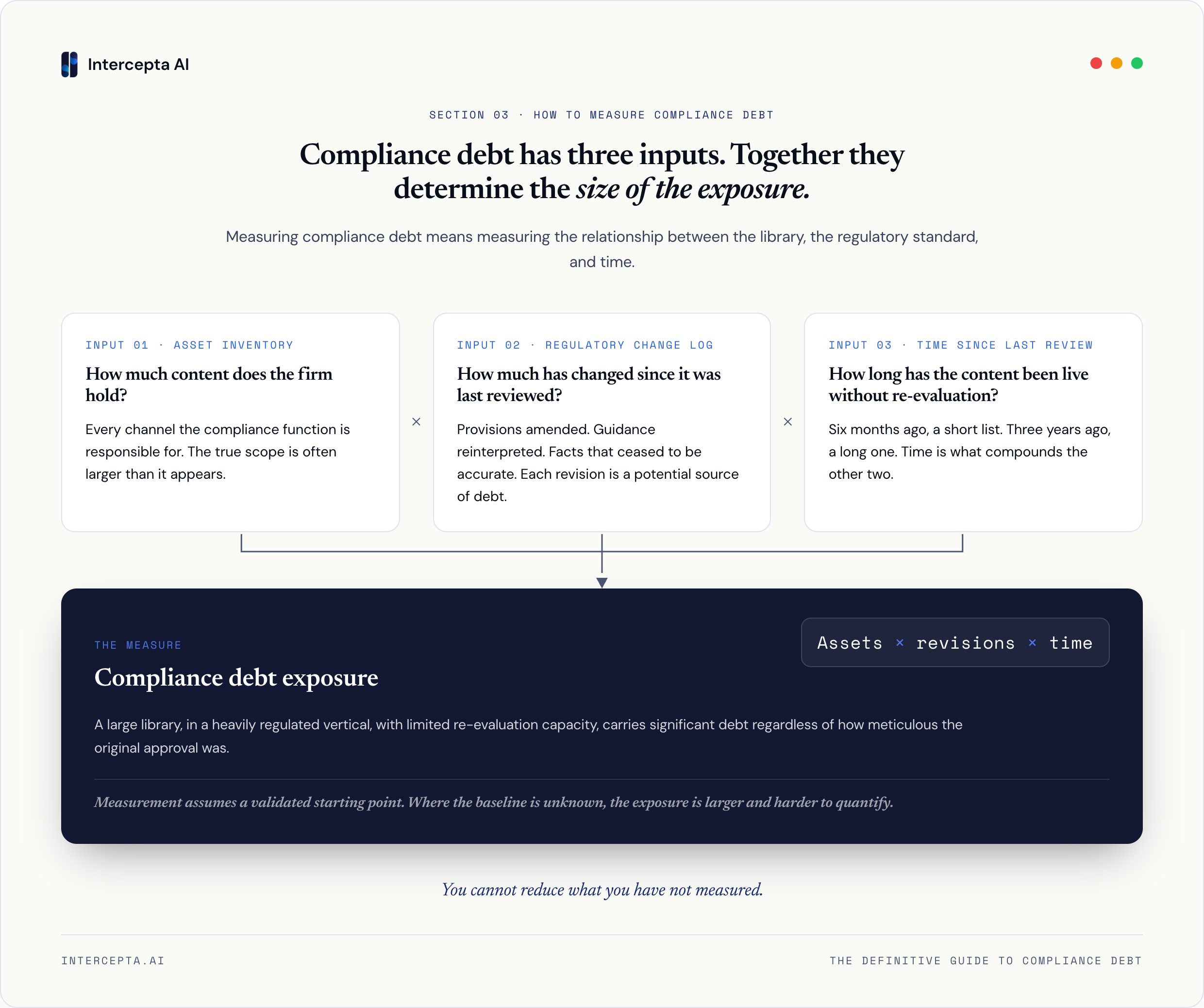
The first is an asset inventory. A firm's live marketing content spans every channel the compliance function is responsible for, and the true scope of that library is often larger than it appears. Content that is not inventoried cannot be assessed, so establishing the actual size of the library is the necessary first step.
The second is a regulatory change log. For each asset, how many of the provisions and facts it depends on have been updated since it was last reviewed? A provision can be amended, reinterpreted through enforcement, supplemented by new guidance, or replaced by a new framework, and a fact the content relied on can simply cease to be accurate. Each such revision since an asset's last review is a potential source of debt on that asset.
The third is time since last review. The longer an asset has been in the public domain without re-examination, the more regulatory revisions have had the opportunity to accumulate against it. An asset reviewed six months ago has a short list of updates to assess. An asset last reviewed three years ago may require more editorial corrections. Time is what compounds the other two inputs.
Together, these factors give a rough but fair measure of a firm's compliance debt. The larger the library, the more heavily regulated the vertical, and the less capacity the firm has for re-examining content after approval, the greater that exposure, regardless of how meticulous the original processes were.
Measurement assumes a validated starting point, because time elapsed since the last review only matters if the content was compliant when it was last approved. Where a library was properly reviewed at publication, the measure captures drift from a known-compliant baseline. Should there be an oversight in the review process, drift and latent non-compliance become entangled, and the exposure is not only larger but harder to quantify, since there is no way to separate what has drifted from what was never compliant to begin with. Weak validation at the point of publication does not create compliance debt, but it makes the debt far harder to measure, because the organisation may no longer know the baseline it is measuring from.
Where compliance debt concentrates
Assets carry different levels of exposure, so a firm reducing its compliance debt does not have to treat its whole library as equally urgent. The content most exposed is the content the regulatory standard governs most tightly, and it is therefore most likely to fall out of compliance when a provision is amended or a fact it relied on shifts. This gives a workable order of priority.
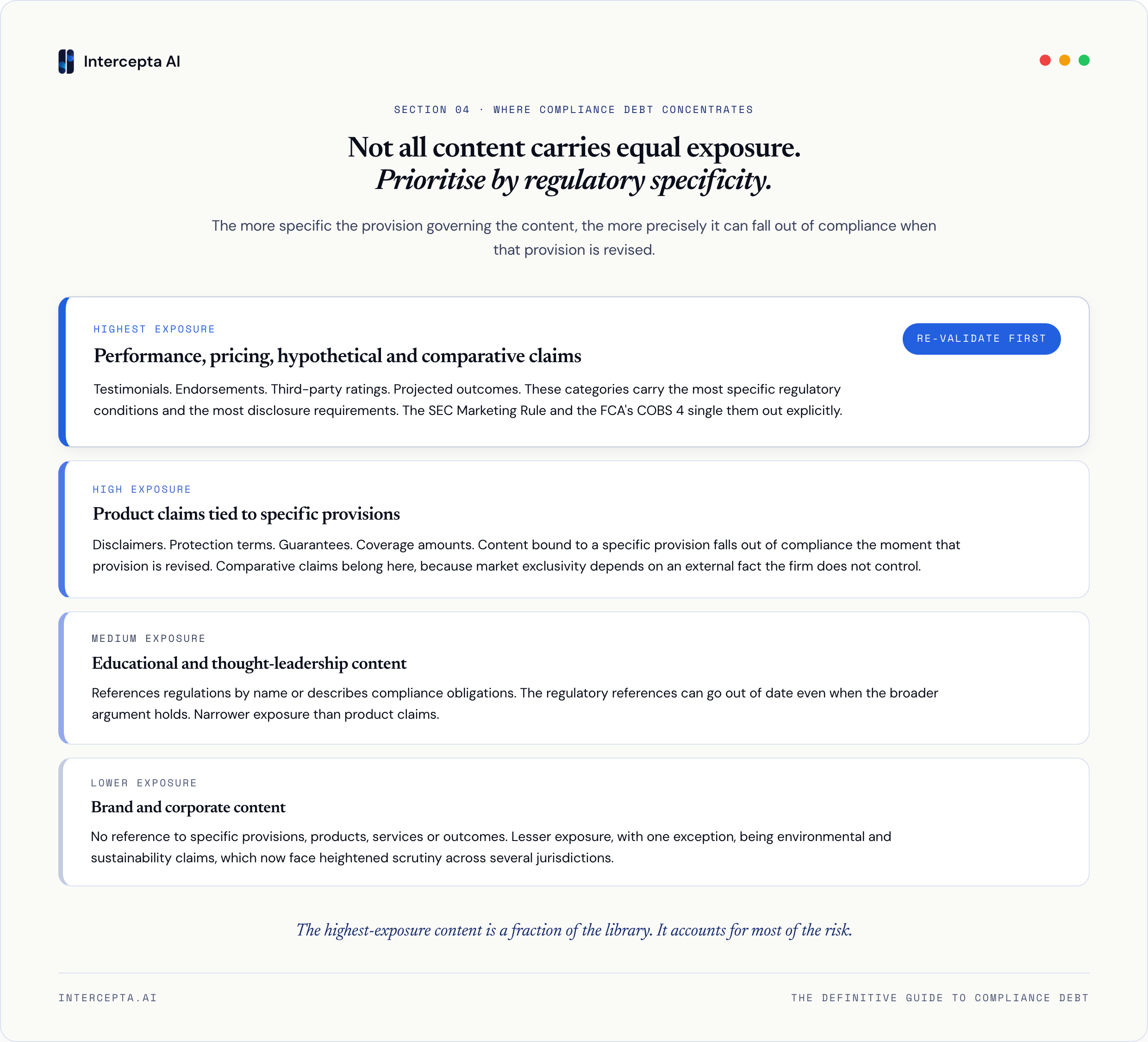
The highest exposure relates to content that makes performance, pricing or comparative claims, or that presents projected or hypothetical outcomes. These are the categories regulators single out for the most specific requirements. The SEC's Marketing Rule treats these categories as requiring the highest level of regulatory specificity. Performance claims, testimonials, endorsements, and third-party ratings each carry their own conditions and disclosure requirements, and advisers must declare on their registration form which of these content types their advertisements contain. The Financial Conduct Authority's (FCA) rules impose their own conditions on past and future performance, requiring prescribed warnings and the disclosure of fees. The more specific the provision, the greater the regulatory exposure when that provision is revised.
High exposure applies to content tied to specific regulatory provisions, being product descriptions, disclaimers, and claims that reference specific protections, guarantees or coverage terms. For example, the FCA's regime for high-risk investments mandates prescribed risk warnings, bans incentives to invest, and requires that risk warnings not be obscured. Content bound to a specific provision falls out of compliance the moment that provision is revised. Comparative claims need to be included here as well, because any assertion of market exclusivity or superiority depends on an external fact that the firm does not control, and a competitor's launch or a price adjustment can falsify the claim overnight while the wording remains untouched.
Medium exposure attaches to educational and thought-leadership content that refers to regulations by name or describes compliance obligations. The regulatory references cited in assets can go out of date even when the broader argument holds, so it needs review. The exposure is however narrower than for content making claims about an organisation's own products or services.
Lower exposure covers brand and corporate content that makes no reference to specific provisions, products, services or outcomes. The exposure here is lesser, though brand content that makes environmental or sustainability claims is an exception, since these claims now face heightened scrutiny in several jurisdictions.
For most firms, the higher-exposure content is a fraction of the total library although it accounts for a disproportionate share of the risk. Re-validation should start there.
How to reduce compliance debt
Reducing compliance debt is a practical process, and this guide breaks it into three core steps. The first two address the existing exposure. The third helps prevent new debt from accumulating.
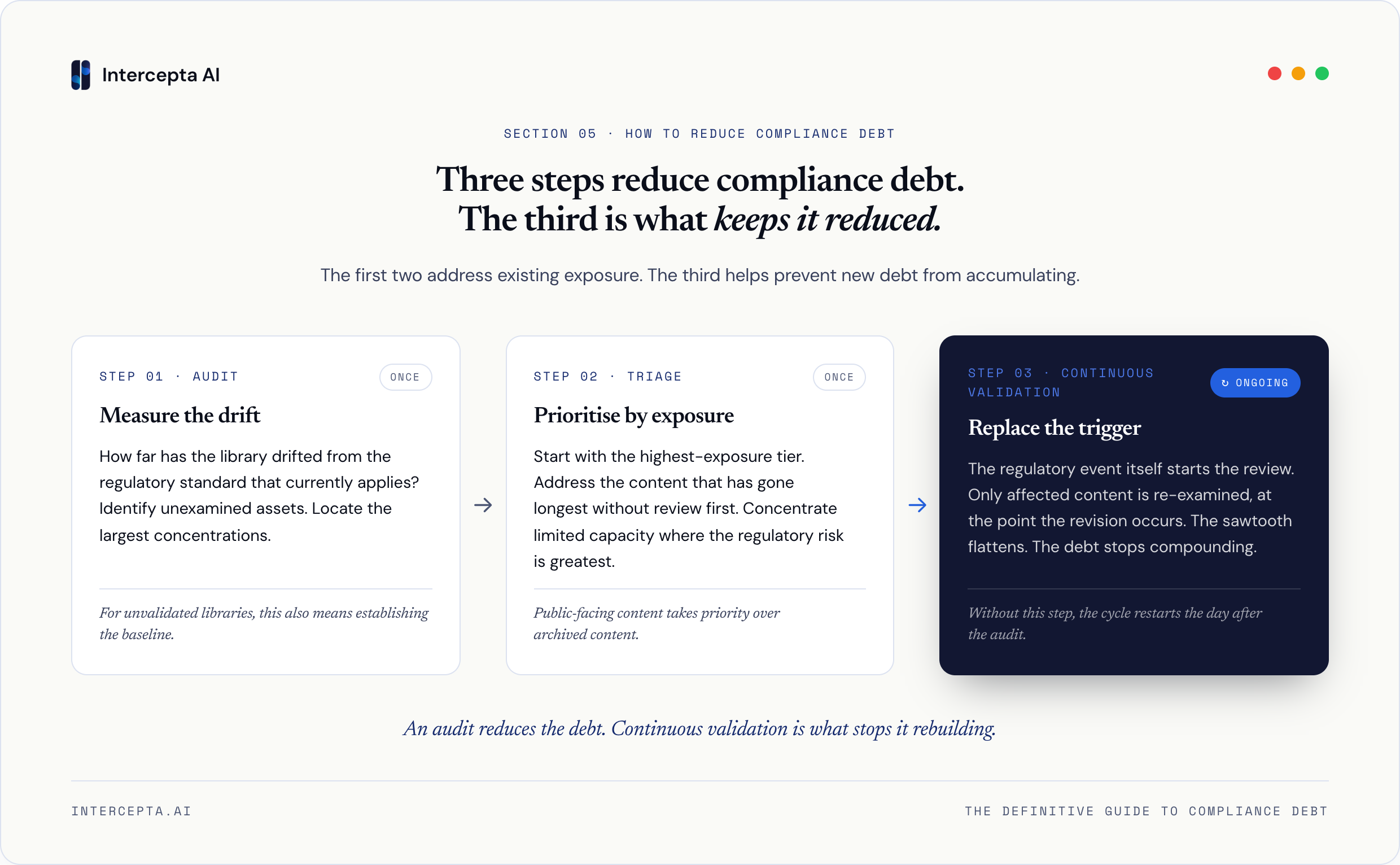
The first step is an audit of how far the library has drifted from the regulatory standard that currently applies. The practical question is how many live assets have gone unexamined since their governing provisions or facts were last updated, and where the largest concentrations are located. For a firm whose content was validated at publication, this measures drift from a known-compliant baseline. For a firm whose content may not have been rigorously reviewed, it means they must establish the baseline that should have existed, which is the more substantial task.
The second step is to triage by the exposure tiers described earlier. Content in the highest tier that has gone longest without review carries the most accumulated debt, and addressing it first concentrates limited capacity where the regulatory risk is greatest. The distinction between content still actively in use and content no longer linked or distributed matters here, since public-facing content is what a customer or regulator will encounter.
The third step is continuous validation, which helps prevent the cycle from restarting. On its own, a single audit does little to prevent new debt from forming. Without a mechanism to flag content when a provision or a fact is revised, the library begins accumulating exposure again once the audit has been conducted. Schedule-driven review, whether quarterly or annual, produces a sawtooth pattern of exposure. After each audit, the debt reduces as non-compliant content is remediated. Between audits, it starts compounding again, because the regulatory standard continues to evolve and the content usually goes unexamined until the following review. The debt is largely addressed at fixed points while it accrues continuously in between, so the average exposure across the year remains higher than it would under a process triggered by the regulatory event itself. Shortening the cycle helps only so far, since auditing the whole library often runs into the same capacity limit that set the interval in the first place.
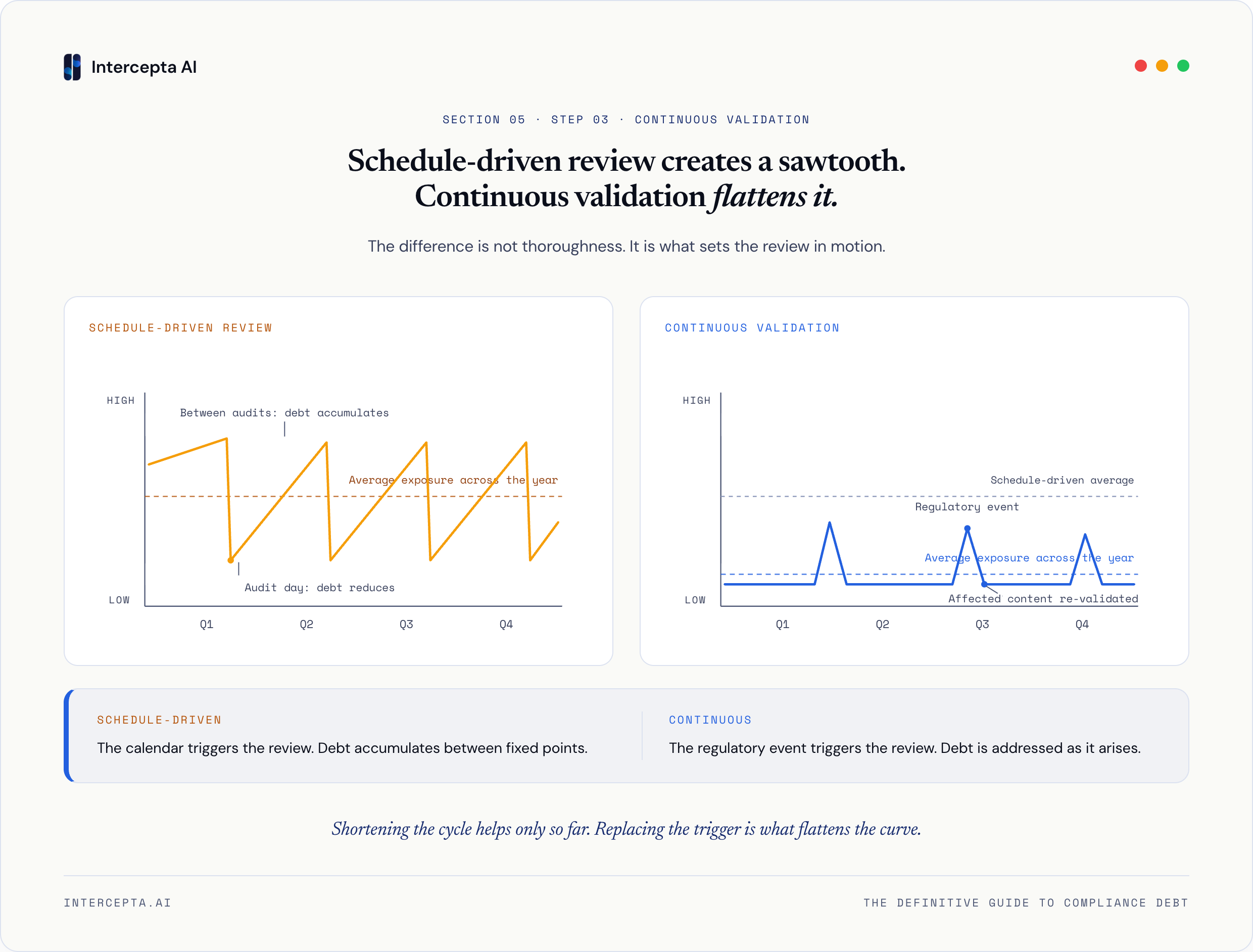
Continuous validation replaces the trigger. Instead of reviewing content on a schedule, the regulatory event itself triggers the review, and the content governed by the amended provision or updated fact is re-examined and revised accordingly. Revision is targeted to these specific assets rather than waiting for the whole library to be re-evaluated the next quarter. The interval between an amendment and the corresponding re-validation shrinks towards zero, the sawtooth flattens, and the average exposure across the year falls with it.
The core difference between the two approaches is what sets the review in motion, not how thorough it is.
What does compliance debt zero look like?
Compliance debt zero does not mean zero liability and risk. New regulatory obligations will keep emerging, and there will always be a short interval between a provision being amended or a fact being superseded and the completion of the corresponding review. The aim is not to eliminate that interval but to keep it short and discernible rather than long and invisible.
In practice, compliance debt zero means a firm re-validates its content at the speed its regulatory environment evolves, rather than at the pace of its audit calendar. Each relevant regulatory event triggers a re-examination of the content that depends on it, and the firm knows, at any point, which of its assets remain compliant, which have drifted, and what specifically needs to be amended. The content library stops being a blind spot. Assets that remain compliant are confirmed as such, and those that have drifted are identified and remediated, with the specific provision or fact that was revised clearly documented.
If a regulator, a board, or an internal audit asks where the library stands, the answer is current, specific, and evidenced.
How Intercepta AI helps reduce compliance debt
Compliance debt zero is built upon two axes operating together: validating content against the applicable regulatory standard and re-validating it when the governing provisions or facts are revised.
An organisation that validates its content at creation establishes the known-compliant baseline that makes its debt measurable, and a firm that re-validates when the standard shifts keeps that debt from compounding. The firm doing both has a content library it can account for. The firm doing neither is carrying exposure it cannot see.
Intercepta AI was built to integrate both axes. When a regulation is amended, the platform automatically re-validates the content held across a firm's digital asset management system, content management system and connected social media channels against the amended requirement.
Each finding identifies the regulatory provision at issue and the nature of the departure, with guidance on how to bring the content into compliance. The review team knows exactly what has drifted and why. Compliant content remains live. Non-compliant content is surfaced and prioritised before it is found externally. The platform covers more than 1,100 regulatory rules across 27 modules, 17 verticals and six jurisdictions, replacing the sawtooth pattern of periodic review with a process triggered by the amendment itself.
Find the compliance debt in your own library
Run one asset through the platform and read the report it returns. It takes less than five minutes. Every issue is mapped to the specific regulation it references, with remediation guidance for your compliance team to review. Your first three scans are free. No payment method required.
Sources
- Financial Conduct Authority, Policy Statement PS23/13 (financial promotions approval gateway), in force 7 February 2024
- Financial Conduct Authority, Conduct of Business Sourcebook (COBS) 4, financial promotion rules including past and future performance
- Financial Conduct Authority, Policy Statement PS22/10 and COBS 4.12A to 4.12B (financial promotion rules for high-risk investments), in force 1 February 2023
- Financial Conduct Authority, Policy Statement PS23/6 (financial promotion rules for crypto assets), in force 8 October 2023
- United States Securities and Exchange Commission, Rule 206(4)-1 (Investment Adviser Marketing), 17 CFR 275.206(4)-1
- United States Securities and Exchange Commission, Division of Examinations Marketing Rule Risk Alerts, 2022 to 2025
- Advertising Standards Authority and Committee of Advertising Practice, Annual Report 2024 (Active Ad Monitoring scanned 28 million advertisements in 2024; 94 per cent of amendments and withdrawals system-flagged), April 2025
- Regulation (EU) 2024/1689 (EU AI Act), Article 50 transparency obligations, applying 2 August 2026