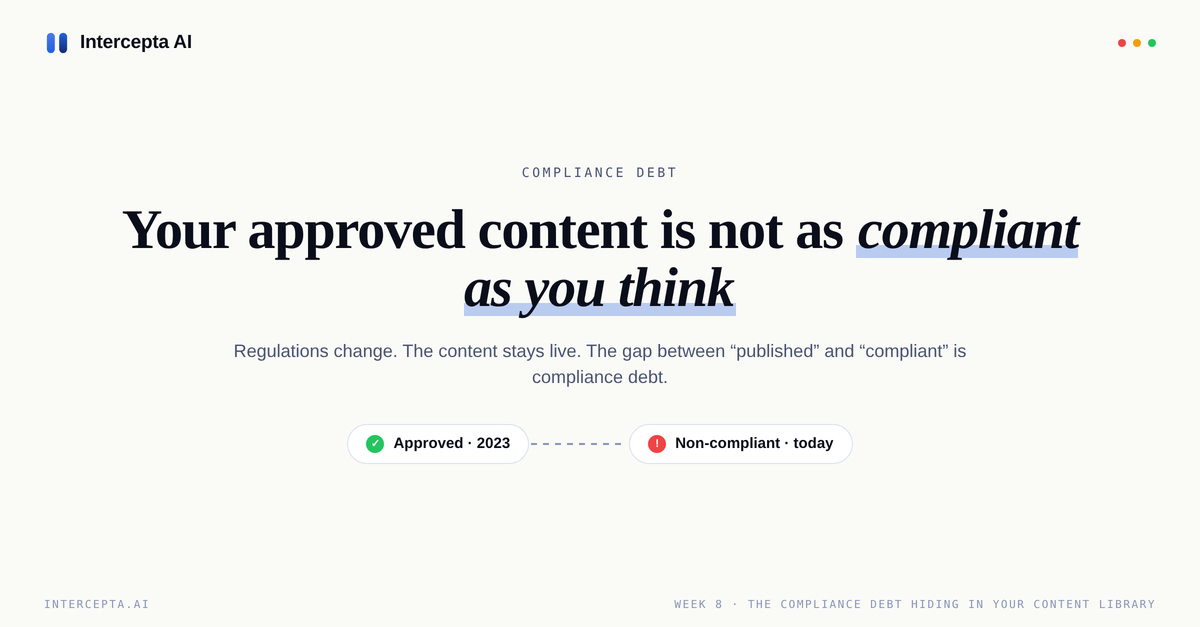
The obligation to keep marketing content compliant runs for as long as it stays live. Regulators have changed the way they act on it. Supervision that once largely waited for a complaint has become proactive and continuous, and an asset that was signed off and filed can now be examined by a regulator at any point in its life.
This shift exposes a form of risk many organisations do not track. Left unmanaged, it compounds like a debt. Compliance debt is the regulatory exposure that accumulates when content that was compliant at publication becomes non-compliant. The asset was reviewed and approved against the requirements and the facts that held on the day. The rules were then amended, or the underlying facts changed, so the prior approval does not match the current requirements any more.
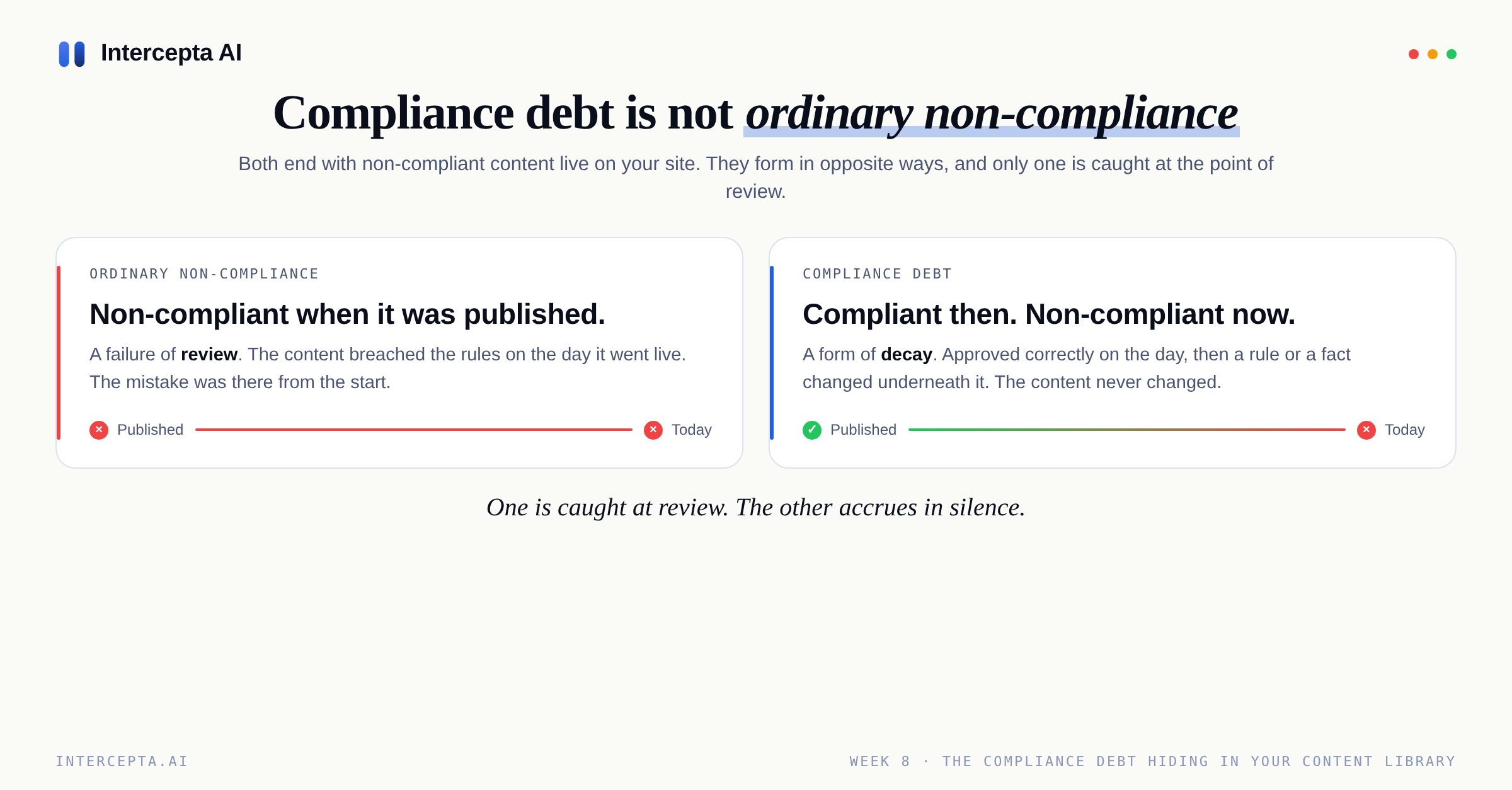
Compliance debt is easily confused with ordinary non-compliance, but the two are distinct. Ordinary non-compliance is content that breached the rules when it was published, a failure at the point of review. Compliance debt is content that was compliant at publication and later fell out of compliance without being changed. One is a failure of review. The other is a form of decay. Like any debt, it accrues quietly and grows the longer it is left.
Why live content is now a live risk
Four regulators, across four jurisdictions, show the same change in posture.
In the United Kingdom, the Financial Conduct Authority (FCA) introduced a gateway for firms that approve financial promotions, in force from 7 February 2024. Firms must monitor the promotions they have approved for continued compliance. The FCA is explicit that where a promotion is still being communicated and a firm becomes aware that it has fallen out of compliance, the organisation must withdraw its approval. In its own rules, the regulator is describing content that was compliant when approved but no longer is. Alongside this, the FCA reviews promotions that are already live, not only those awaiting approval.
In the United States, the Securities and Exchange Commission (SEC) built the same principle into the text of its Marketing Rule. An adviser may not make a material statement of fact in an advertisement unless it has a reasonable basis for believing it can substantiate that statement upon demand by the Commission. The obligation is continuous. The demand can come at any point while the content is live, and the Division of Examinations has issued a series of risk alerts, from 2022 through to late 2025, reporting deficiencies found when it reviews advisers advertising across websites, social media, pitch books and email.
In Australia, the same shift has reached beyond financial services. The Australian Securities and Investments Commission (ASIC) ran proactive surveillance of sustainability claims across sectors, from energy and mining companies to managed funds and superannuation, set out in reports of May 2023 and August 2024, and obtained corrective disclosure where it found claims that lacked a reasonable basis. The pattern is not confined to one market. In Canada, the Canadian Securities Administrators (CSA) ran Environmental, Social and Governance (ESG)-focused reviews of investment fund prospectuses, sales communications and continuous disclosure, 112 in the prospectus stream alone, and reported in Staff Notice 81-334 in March 2024 that they had found funds whose marketing overstated the role ESG played in how they actually invested.
The common thread is that being compliant on the day of publication does not discharge the obligation. Live content sits under continuous review, and the assets most exposed are those that have not been re-examined since they were approved.
How compliant content falls out of compliance
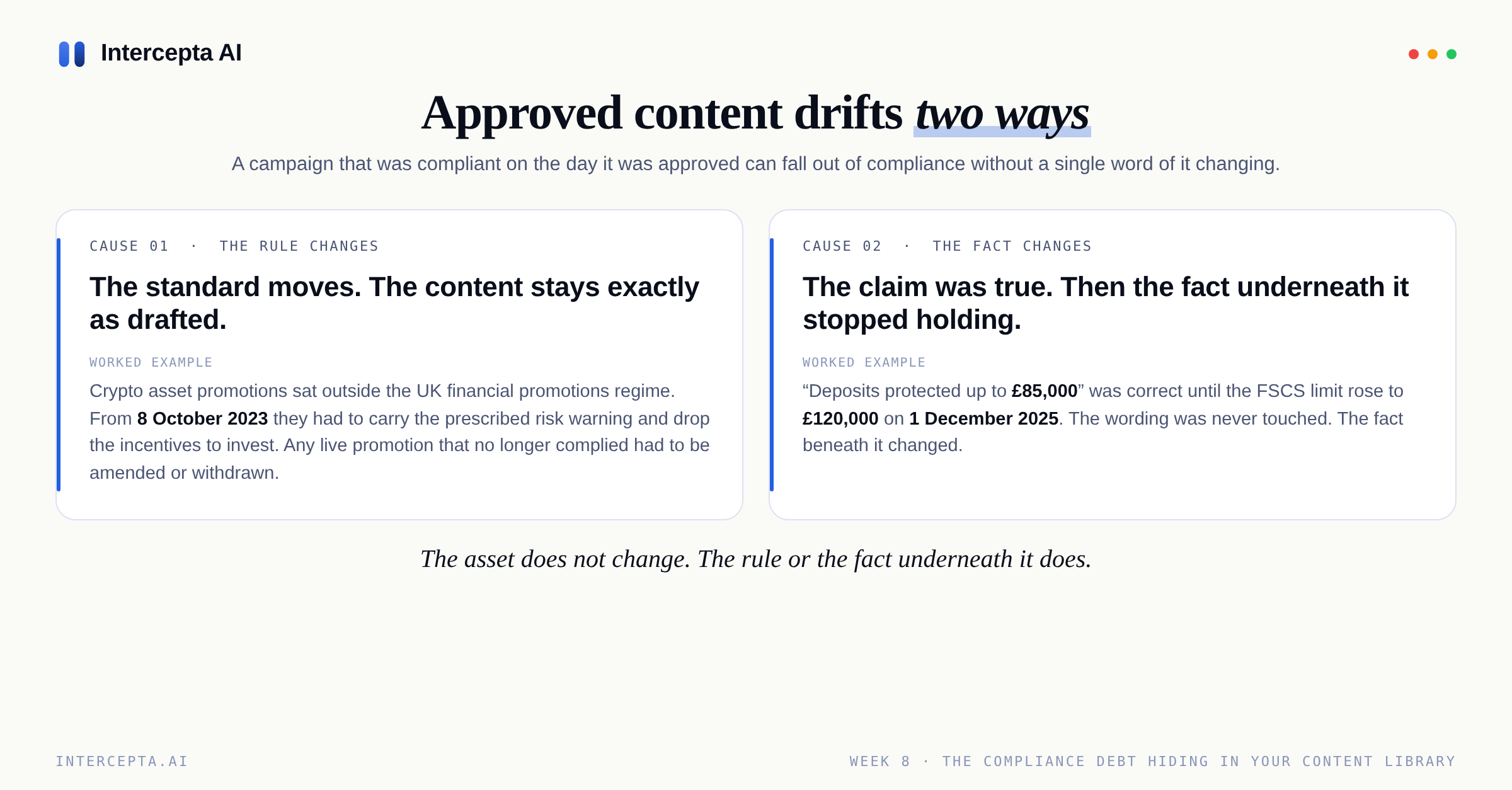
Content that was compliant when published falls out of compliance in two ways.
The first is an amendment to the rules. Content is approved against the requirements in force on the day. When those requirements are revised by regulators, the content stays exactly as drafted while the standard beneath it shifts. Two dated examples illustrate how a rule change catches content that is already live. Before 8 October 2023, most crypto asset promotions fell outside the remit of the United Kingdom financial promotions regime, so they needed no authorised firm's approval and none of its risk warnings or consumer protections. When the regime was extended to cover them, a promotion that had been lawful the day before had to carry the prescribed risk warning and drop the incentives to invest that were now prohibited. From that date, firms had to amend or withdraw any live promotion that no longer complied. From 2 August 2026, the European Union's AI Act requires deployers to disclose when image, audio or video content that could appear authentic has been generated or manipulated by AI, so synthetic marketing media that can be published today without a label will need one from that date. In each case the asset does not change. The rule governing it does, and the asset no longer meets it.
The second is a change in the facts. A claim that was substantiated when published can cease to be accurate when a fact it relied on ceases to hold, even though the wording was never touched. A statement that deposits are protected up to £85,000 was correct until the Financial Services Compensation Scheme limit rose to £120,000 on 1 December 2025. A claim to be the only provider of a feature holds until a competitor launches an equivalent product. A figure, a threshold, a comparative, a cited statistic, each is accurate on the day it is written, but claims of this kind carry a shelf life. The copy does not change. The fact underneath it does.
Why compliance debt accrues unnoticed
Compliance debt accrues unnoticed because content review is usually initiated at the point of publication, and few processes trigger a second look once an asset is approved. In the marketing workflow, content is reviewed when it is created, approved, filed, and then reused, often long after the compliance review cleared it.
Content usually drifts out of compliance because of an external change the firm does not control, when the regulator amends a rule, a threshold moves, or a competitor launches a similar product. It often goes unnoticed because it rarely reaches the team that owns the asset, and there is no automatic signal that the rules or facts have changed. Over time, the assets that carry the most risk are the ones that have been live the longest without re-examination.
The cost of compliance debt
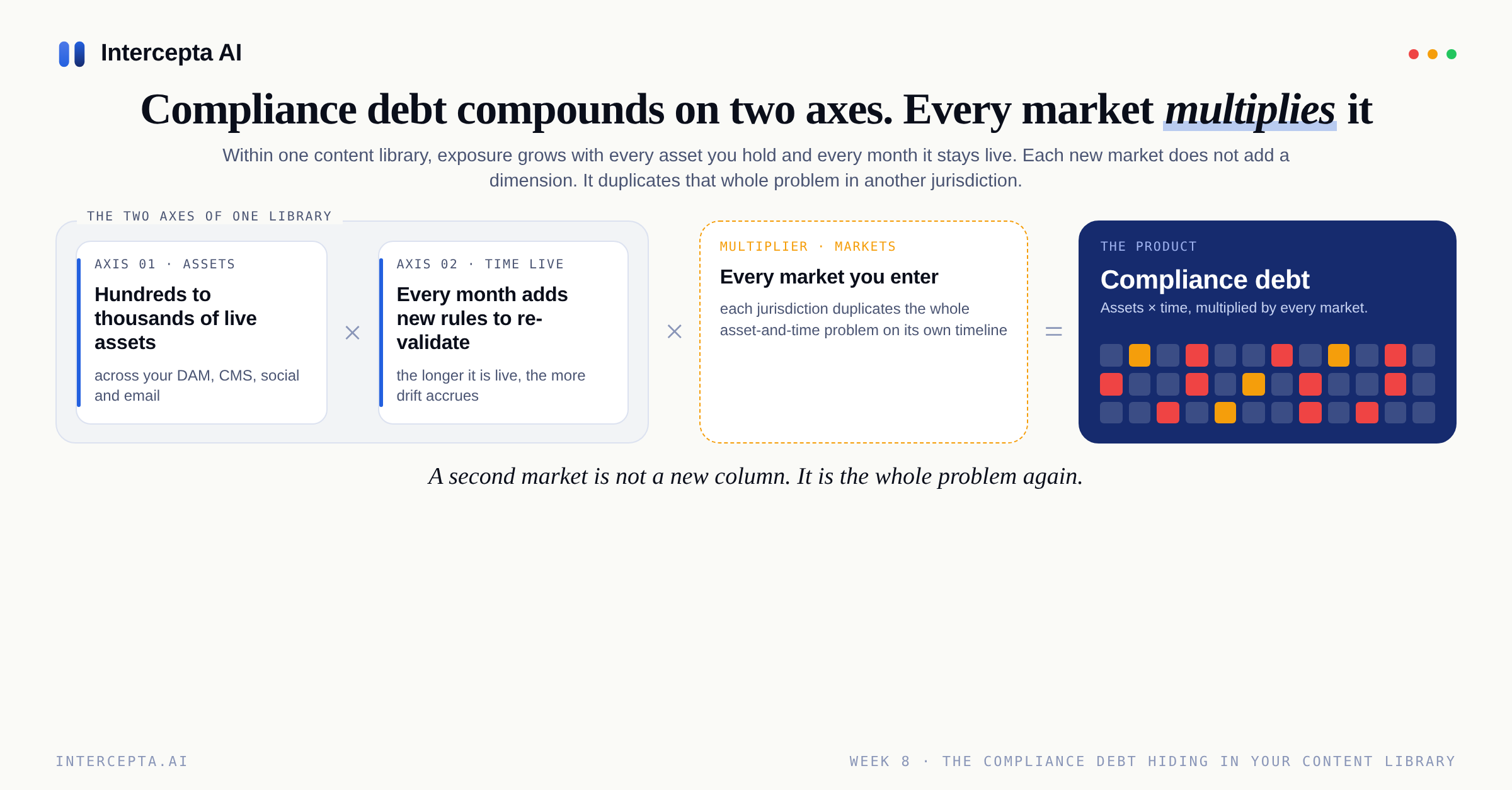
Compliance debt compounds. The exposure on any one asset deepens each time a rule or fact it depends on changes again, and every such revision sweeps a fresh set of previously compliant assets into non-compliance. The exposure grows on two axes at once, being the number of assets a firm holds and the length of time they stay live, and each additional market multiplies both, since every market brings its own rules moving on their own schedule.
Compliance debt that is not serviced is a live liability rather than a dormant one. For as long as a non-compliant asset remains published, it can surface in three ways. A regulator may find it on the kind of proactive review described earlier, a customer or competitor may challenge it, or the firm may discover it too late and must correct it under a deadline it did not set. Detection by a regulator no longer depends on someone complaining. In the United Kingdom, the Advertising Standards Authority now runs an AI-based system that scanned 28 million online advertisements in 2024. Of those it amended or withdrew that year, 94 per cent were flagged by the system rather than by a public complaint. Proactive detection of live advertising has become automated and runs at scale, so content sitting in the open is far more likely to be found than it was. When a rule changes, correcting it is rarely a single edit. A firm must find the affected assets across its content library, decide what to amend and what to withdraw, and meet the compliance date the regulator has fixed, all while the usual flow of new content still arrives for approval.
The scale of the task is not hypothetical. When the Financial Conduct Authority's Consumer Duty raised the standard for customer communications in 2023, firms had to review the material they were still using and revise whatever fell short, and for closed products, being those no longer sold, they had until 31 July 2024 to do the same for communications built up over years. A rule changed, and an industry had to work back through content that had been compliant when it was written. The larger and older the library, and the more markets it spans, the more assets a single rule change puts in scope, and the more of that work must happen at once.
Servicing the debt
Compliance debt is serviceable, and it does not require reviewing a whole library on a schedule. The work is re-validation at the single moment that matters, when a rule or fact an asset depends on changes, which closes the exposure as it arises rather than leaving it to surface later. This is the logic regulators are already applying to live content, and it is the logic a firm can apply to its own library.
This is the principle Intercepta AI was built around. When a regulation changes, the platform re-scans the content held across the digital asset management system, content management system and connected social channels against the new requirement, and maps each finding to the specific regulation it references, with remediation guidance for a compliance team to review. Content that still complies is left in place. Content that has fallen out of compliance is flagged, before a regulator or a customer finds it first. AI built the content. AI should validate it before your team reviews it.
Find the compliance debt in your own library
Run one asset through the platform and read the report it returns. It takes less than five minutes. Every issue is mapped to the specific regulation it references, with remediation guidance for your compliance team to review. Your first three scans are free. No payment method required.
Sources
- Financial Conduct Authority, Policy Statement PS23/13 (financial promotions approval gateway), in force 7 February 2024
- Financial Conduct Authority, Financial Promotions Data 2024, February 2025
- Advertising Standards Authority and Committee of Advertising Practice, Annual Report 2024 (Active Ad Monitoring scanned 28 million ads in 2024; 94 per cent of amendments and withdrawals system-flagged), April 2025
- Financial Conduct Authority, Policy Statement PS23/6 (financial promotion rules for crypto assets), in force 8 October 2023
- Regulation (EU) 2024/1689 (EU AI Act), Article 50 transparency obligations, applying 2 August 2026
- United States Securities and Exchange Commission, Rule 206(4)-1 (Investment Adviser Marketing), 17 CFR 275.206(4)-1
- United States Securities and Exchange Commission, Division of Examinations Marketing Rule Risk Alerts, 2022 to 2025
- Australian Securities and Investments Commission, Report 763 (recent greenwashing interventions), May 2023
- Australian Securities and Investments Commission, Report 791 (greenwashing interventions 2023 to 2024), August 2024
- Canadian Securities Administrators, Staff Notice 81-334 (Revised) ESG-Related Investment Fund Disclosure, March 2024
- Bank of England / Prudential Regulation Authority, FSCS deposit protection limit increased from £85,000 to £120,000, effective 1 December 2025
- Financial Conduct Authority, Policy Statement PS22/9 (A New Consumer Duty), July 2022, in force 31 July 2023 for open products and 31 July 2024 for closed products. Financial Conduct Authority, Finalised Guidance FG22/5, consumer understanding outcome (PRIN 2A.5)