New York's first-in-the-nation synthetic performer disclosure law took effect on 9 June 2026. If your agency produces advertising that contains an AI-generated or software-generated human figure, and that advertising could reach a New York audience, you are now within its scope.
Can you prove, asset by asset, that you complied?
When an enquiry lands, the advertiser who can produce a documented, pre-publication record of what was validated and when can show the steps they took to abide by the rule.
What the law requires
Governor Kathy Hochul signed S.8420-A/A.8887-B into law on 11 December 2025. It amends New York General Business Law section 396-b and took effect on 9 June 2026, one hundred and eighty days after signing.
The law requires a person who produces or creates an advertisement to make a "conspicuous disclosure" when that advertisement contains a synthetic performer. A synthetic performer is defined narrowly but in a way that catches more than many teams expect. It is a digitally created asset that meets two conditions. First, it is created, reproduced, or modified by computer, using generative AI or a software algorithm. Second, it is intended to give the impression of an audiovisual or visual performance by a human performer who is not recognisable as any identifiable real person.
Two points in that definition matter for production teams. The reference to a "software algorithm" means the rule reaches beyond generative AI tools. Traditional computer-generated imagery used to create a human figure can fall within scope. At the same time, the law carves out digital replicas of identifiable real people, such as recognisable copies of celebrities, because those uses are governed by separate publicity and likeness laws.
The statute does not define "conspicuous." The meaning is left for market practice and enforcement to settle over time. The reasonable working standard is that a disclosure should be noticeable, legible, and understandable to an ordinary consumer rather than buried in fine print.
Why agencies are squarely in the frame
The law reaches two groups, and agencies sit in the first.
Creators and producers are within scope if they produce an advertisement and have actual knowledge that it contains a synthetic performer. It does not matter whether the figure is the star of the spot or appears only in the background. A synthetic background performer triggers the same obligation as a synthetic lead.
Publishers and distributors are addressed separately. A platform that receives notice of an undisclosed synthetic performer in an advertisement it carries must take the advertisement down or bring it into compliance within five days. The statute expressly states that it does not intend to limit or enlarge the protections afforded by Section 230 of the Communications Decency Act. Reed Smith's reading is that Section 230 is unlikely to provide an enforcement shield once that notice has been received. Other firms interpret the statutory language as preserving the existing Section 230 position without change. How enforcement will treat that boundary remains to be seen.
The reach test is what makes this a national issue rather than a New York one. The obligation applies to any advertisement that could reach a New York audience, regardless of where the advertiser or agency is based. If a campaign is national or international, it can reach a New Yorker, and the rule applies.
Enforcement rests with the New York Attorney General. There is no private right of action. Penalties are set at $1,000 for a first violation and $5,000 for each subsequent violation. Those per-violation figures look modest in isolation, but the statute does not specify how a violation is counted. For a high-volume advertising operation running multiple or continuous campaigns with synthetic content, exposure can scale quickly, and that uncertainty is itself a reason to document compliance carefully.
There are limited exceptions. Advertisements for expressive works such as films, television, and video games are exempt where the synthetic performer's use in the advertisement is consistent with its use in the underlying work. Audio-only advertisements are not covered, and neither is the use of AI solely to translate the language of a human performer.
This is why counsel advising on the law points agencies first at their contracts and their intake. Reed Smith's guidance to advertisers is to inventory campaigns that use digital humans, update creative review workflows to flag synthetic performer use, and tighten contracts with agencies and vendors so that responsibility for identification and disclosure is allocated in advance rather than argued about afterwards.
The wider shift toward mandatory disclosure
New York is the first state to legislate on synthetic performer disclosure. The direction is consistent across more than one jurisdiction.
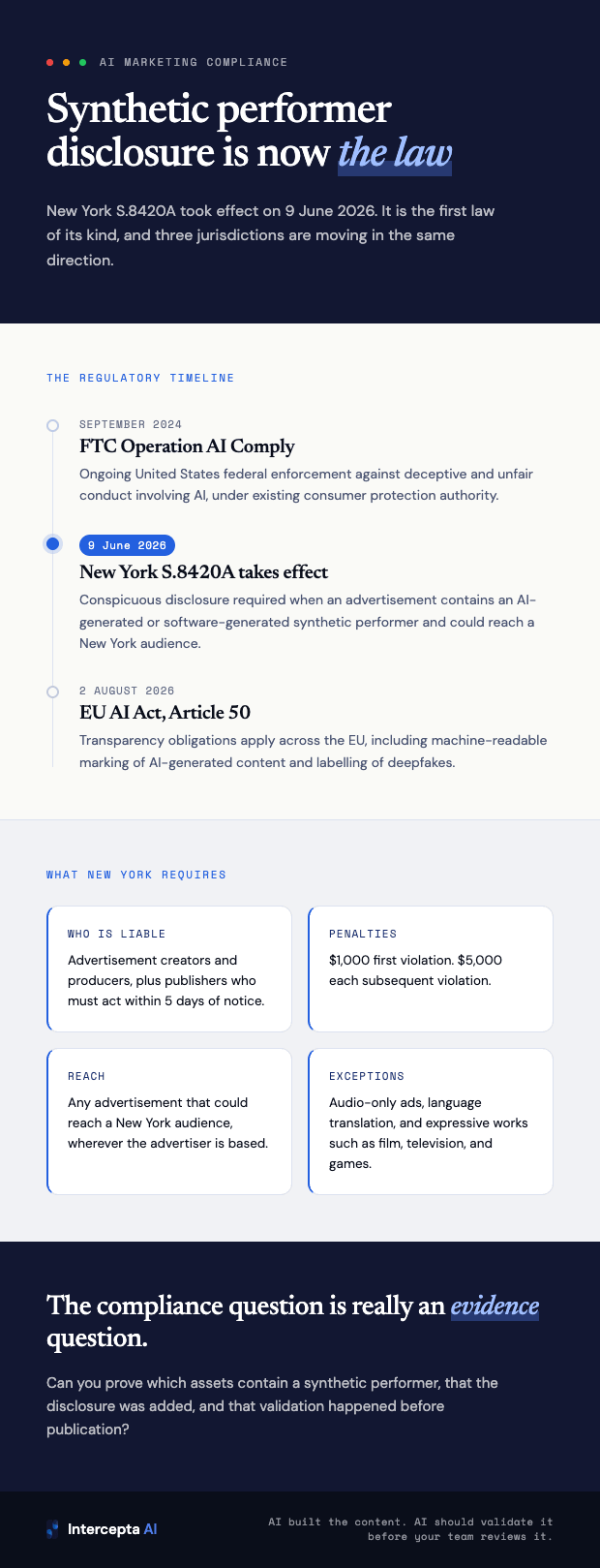
The AI advertising disclosure timeline across the FTC, New York, and the EU.
In the European Union, the transparency obligations under Article 50 of the EU AI Act become applicable on 2 August 2026, within the same quarter as New York's effective date. Article 50 requires providers of generative AI systems to mark synthetic audio, image, video, and text in a machine-readable format, and it requires deployers to label deepfakes and certain AI-generated content. Like the New York law, it has extraterritorial reach. It applies to organisations that place AI systems on the EU market or use AI professionally within the EU, regardless of where the organisation is headquartered. If your marketing reaches European audiences, it applies to you.
At the United States federal level, the picture is one of active enforcement against deception rather than a single disclosure mandate. The Federal Trade Commission's Operation AI Comply, launched on 25 September 2024 and continuing since, applies the agency's existing authority under Section 5 of the FTC Act to deceptive and unfair conduct involving AI. The FTC's position has been that there is no AI exemption from the laws already on the books.
Set against that, a White House Executive Order issued in December 2025 seeks to pre-empt conflicting state AI laws in favour of a future federal standard, which adds legal uncertainty rather than a federal disclosure rule. The practical advice from advisers has been consistent through that uncertainty: continue preparing for compliance with the laws that are in force.
The common thread is straightforward. Across these regimes, the expectation is moving toward telling people that the content they are seeing was made by a machine. The specific mechanics differ, but the underlying obligation to disclose, and to be able to show that you did, is becoming the default.
Intent matters, which makes your records matter more
The second prong of the definition turns on intent. The asset must be intended to give the impression of a human performer. The distinction changes how production teams should think about documentation.
If a brief or a prompt asked for a mannequin or an abstract avatar rather than a believable human, that record can support an argument that the asset was never intended to be perceived as a real person, and therefore falls outside the rule. The defence depends on having kept the record at the point of creation. A creative process that is documented as you go is far easier to stand behind.
Three aspects of the statute give the audit trail its weight, even though the statute itself does not mandate record-keeping.
The first is the intent element because the definition turns on what the asset was intended to depict. A contemporaneous creative brief or prompt is the difference between asserting that intent and demonstrating it.
The second is the knowledge standard. Liability attaches where the creator or producer has actual knowledge that an advertisement contains a synthetic performer. A workflow that identifies and flags synthetic content before publication documents that knowledge and the response to it. The absence of any such process does not create legal safety; it creates a gap that enforcement can characterise as wilful blindness.
The third is the burden of demonstration. The statute requires disclosure but does not prescribe how an advertiser proves that disclosure was made. In any enforcement enquiry, a timestamped validation record is materially stronger than a recollection of what was done.
The statute does not say "keep records." However, the obligations it does impose are far easier to demonstrate with a documented trail than without one.
The compliance question is really an evidence question
When the rules are still settling and enforcement practice is still forming, the safest position is the one you can document. For any campaign that could reach a regulated audience, three questions highlight whether you are exposed:
- Can you prove which assets in a campaign contain a synthetic performer?
- Can you prove that the required disclosure was added before the content went live?
- Can you prove that a validation step happened before publication, rather than after a complaint?
An agency that can answer these three questions with a record has turned a compliance obligation into a defensible position.
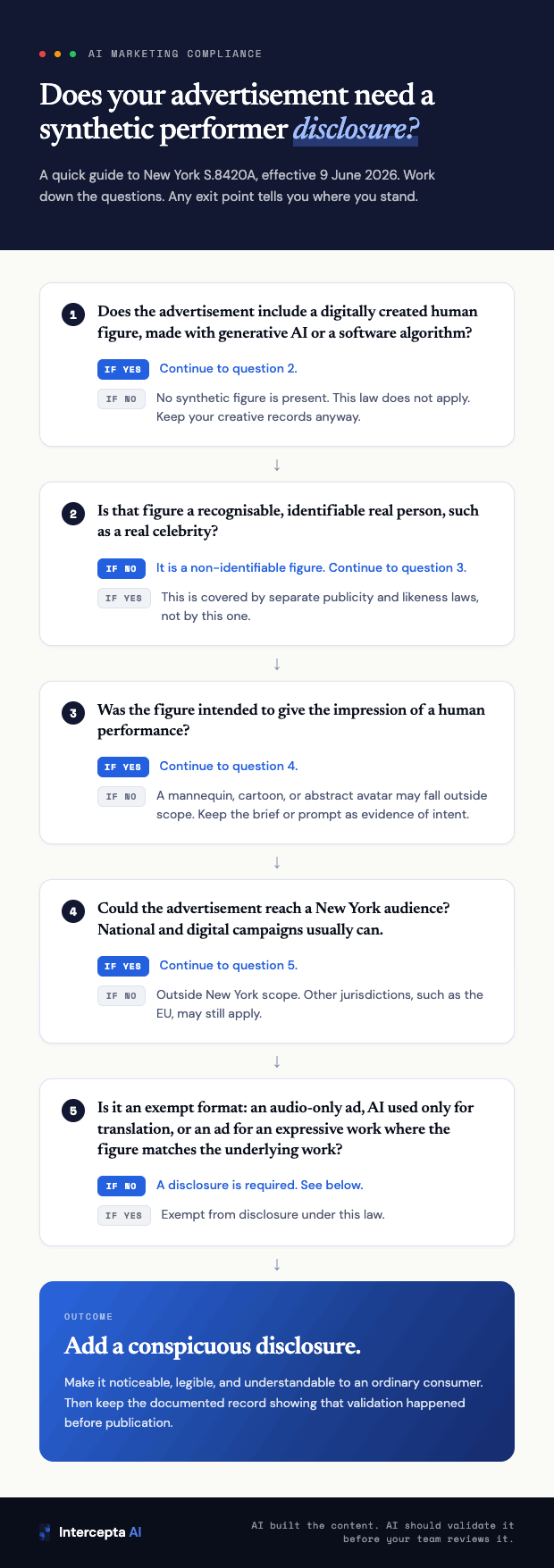
Does your advertisement need a synthetic performer disclosure under New York S.8420A?
What your team may have done already
If your agency has been following the guidance published by firms such as Reed Smith and McDermott since the law was signed, several of the recommended steps may already be in place, including an inventory of campaigns that use digital humans or simulated content and updated creative review workflows that flag synthetic performer use.
Those are the right foundations. Those foundations do not yet produce a documented, timestamped record showing that a specific asset was assessed against the disclosure obligation and validated before publication. The inventory identifies which campaigns to look at. The workflow tells the team to flag synthetic content. However, when an enforcement enquiry asks whether the disclosure was in place for a particular advertisement on a particular date, the answer needs to be a record, not a reconstruction.
How Intercepta AI fits
Intercepta AI validates static marketing content against the regulatory rules that apply to it before that content is published. Every scan produces a documented record of what was validated and when.
For marketing and creative teams, that means the disclosure requirements now in force are assessed as part of the normal pre-publication workflow rather than added at the end. For compliance teams, it means a timestamped record of every scan, so that the evidence exists before anyone asks for it. The review still belongs to the team. Intercepta AI makes it faster and gives it something concrete to stand on.
AI built the content. AI should validate it before your team reviews it.
Validate before you publish
Your first three scans are free
No payment method required.
Sources
- New York State, Office of the Governor. Press release, "Governor Hochul Signs Legislation to Protect Consumers and Boost AI Transparency in the Film Industry." 11 December 2025.
- New York State Senate. Senate Bill S.8420-A / Assembly Bill A.8887-B, amending New York General Business Law section 396-b. Effective 9 June 2026.
- Reed Smith. "Fake performer, real penalty: what advertisers need to know before June 9." June 2026.
- Cooley. "New York Enacts 'Synthetic Performer' Disclosure Law for Advertisements, Including Those Using Generative AI." 29 January 2026.
- Skadden, Arps, Slate, Meagher & Flom. "Two Newly Enacted New York Laws Will Regulate Certain AI-Generated Images." January 2026.
- Davis+Gilbert. "AI Legal Updates: Synthetic Performer Transparency; State and Federal Conflict." December 2025.
- McDermott. "New York's Synthetic Performer Disclosure Law: What Advertisers Need to Know." June 2026.
- Lydia F. de la Torre, Golden Data. "What is New York's Synthetic Performer Disclosure Law?" May 2026.
- European Commission. Transparency obligations under Article 50 of the EU AI Act. Applicable from 2 August 2026.
- US Federal Trade Commission. "FTC Announces Crackdown on Deceptive AI Claims and Schemes" (Operation AI Comply). 25 September 2024.